The Non-Emergency Medical Transportation industry is growing rapidly. The industry helps elderly and disabled patients reach medical appointments. NEMT services are essential for dialysis, chemotherapy, and routine checkups.
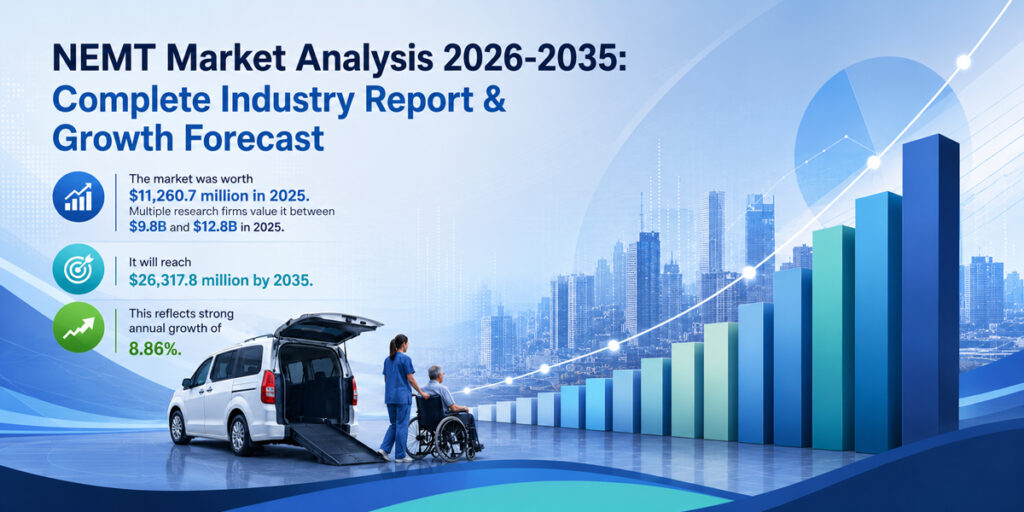
The market was worth $11,260.7 million in 2025. Multiple research firms value it between $9.8B and $12.8B in 2025. It will reach $26,317.8 million by 2035. This reflects strong annual growth of 8.86%.
NEMT Market Size and Forecast 2026–2035: Revenue & Growth Projections
The global NEMT market shows impressive growth.
| Year | Conservative | Mid Estimate | Aggressive |
| 2025 | $9.82B | $11.26B | $12.21B |
| 2026 | $10.5B | $12.3B | $13.4B |
| 2027 | $11.3B | $13.4B | $14.7B |
| 2028 | $12.1B | $14.6B | $16.1B |
| 2030 | $13.9B | $17.3B | $19.3B |
| 2035 | — | $26.3B | — |
More than 65% of usage is in elderly care. Dialysis patients rely heavily on NEMT services. Routine hospital visits drive significant demand. By 2035, the market will surge to $26,317.8 million. The U.S. alone accounts for 41–45% of global revenue.
Growth comes from several key factors. The aging population increases healthcare needs by 55%. Insurance-covered transport services increased by more than 40%. Chronic disease prevalence keeps rising steadily. Home healthcare adoption grows every year. Investments in wheelchair-accessible vehicles are increasing constantly.
3.6 million Americans miss medical appointments yearly. They simply cannot get transportation. This costs the U.S. healthcare system $150 billion annually.
The U.S. NEMT market reports lead global growth. An aging population drives demand higher. Accessible healthcare mobility solutions are becoming increasingly critical. Ride-sharing platforms improve booking efficiency.
Top NEMT Market Trends 2026 & Growth Drivers
NEMT stands for Non-Emergency Medical Transportation. These services transport patients to medical appointments. NEMT is not for emergencies. It facilitates patients’ safe access to dialysis centers. Physical therapy sessions require reliable transport. Specialized medical treatments need scheduled rides.
| Research Firm | CAGR Projection | 2030–2031 Target |
| The Insight Partners | 9.7% | $31.87B |
| Mordor Intelligence | 8.23% | $18.93B |
| Research and Markets | 7.23% | $13.93B |
| Business Research Company | 7.7% | $13.71B |
| 360iResearch | 7.13% | $13.87B |
| Consensus Range | 7.1%–9.7% | — |
The adoption of ride-hailing platforms increased 30%. This improves service efficiency significantly. Government-funded healthcare programs drive market growth. Medicaid-sponsored transportation services expand access.
Market Size
The market was valued at $11,260.7 million in 2025. It will reach $22,208 million by 2033. The growth rate stands at 8.86% CAGR.
Growth Drivers
- Medicaid-funded rides account for 60%
- Elderly transport demand increased 50%
- Wheelchair van needs grew 35%
- AI scheduling adoption reached 40%
- Rural patient reliance jumped 40%
- Ride-hailing platforms grew 30%
- Every $1 invested in NEMT generates $11 in healthcare savings
Market Trends
- App-based booking handles 40% of rides
- Wheelchair van usage reached 35%
- Stretcher transport grew 30%
- AI scheduling tools improved 40%
- Telehealth drives 25% more demand
- Insurance-funded NEMT rose 30%
- Mental health transport is the fastest-growing at 10.11% CAGR
- Home healthcare settings grow fastest among end users at 10.17% CAGR
Regional Market Insights
| Region | Market Size | Market Share | CAGR |
| North America | $9,559.4M | 43% | 8–9% |
| Europe | $6,218.2M | 28% | 6–7% |
| Asia-Pacific | $4,663.7M | 21% | 10.24% |
| Middle East & Africa | $1,776.6M | 8% | 7–8% |
- North America dominates with 45% share
- Europe holds 25% of the market
- Asia-Pacific accounts for 20%
- The US contributes 80% within North America
- Asia-Pacific is now the fastest-growing region at 10.24% CAGR.
- China alone is projected to reach $5 billion by 2030.
- Wheelchair van demand up 35%
- Ride-hailing platforms grew 50%
- Rural expansion increased 35%
Industry Challenges
| Challenge | Impact |
| Driver turnover | Exceeds 64% annually |
| Claim denial rate | 15–25% per provider |
| Payment cycle | 30–60+ days |
| Rural vehicle shortage | 40% gap in coverage |
| Missed appointments | 30% caused by NEMT gaps |
NEMT drivers compete for wages against gig economy and delivery jobs. This shrinks the qualified labor pool significantly. Average driver tenure is just 8–12 months.
- Fleet maintenance costs rose 30%
- The driver shortage increased 25%
- Insurance coverage is limited to 45%
- Rural vehicle shortage hits 40%
- Compliance costs pressure providers 20%
- Missed appointments reach 30%
Industry Impact
- Medicaid expansion drives 40% growth
- AI scheduling improves efficiency 30%
- Autonomous vehicle pilots up 25%
- Electric wheelchair van adoption 35%
- Real-time tracking systems up 40%
- Insurance investments rose 30%
Recent Market Developments
- Lyft’s Medicaid transportation services increased 40%
- ModivCare AI tools boost efficiency 30%
- MTM reduced no-shows by 25%
- FirstGroup launched electric vans, cutting emissions 35%
- Veyo improved dispatch efficiency 20%
NEMT Industry Trends: Technology, AI & Ride-Sharing Growth
The NEMT market evolves with technology. Ride-sharing models gain wider adoption. AI-based scheduling systems improve efficiency. Cost-effective patient transportation becomes more accessible. App-based NEMT services increased 40%.
| Technology | Monthly Investment | Typical ROI | Payback Period |
| Scheduling software | $200–500 | 300–500% | 3–6 months |
| Route optimization | $300–800 | 200–400% | 4–8 months |
| Billing automation | $400–1,000 | 400–600% | 2–5 months |
| Fleet management | $15–40/vehicle | 150–300% | 6–12 months |
Hospitals partner with transportation network companies. Uber and Lyft provide convenient medical rides. These partnerships improve patient access significantly. Technology enables better coordination of services.
Medicaid and Government Funding
Medicaid-funded NEMT services account for 60%. This reflects growing reliance on government programs. Medicaid NEMT spending exceeds $3 billion annually. This represents less than 1% of total Medicaid spend. 21 states raised NEMT reimbursement rates in FY2024. Illinois increased rates by 40%. Ohio raised certain service rates by 79%.
Wheelchair-Accessible Vehicle Demand
Wheelchair-accessible vehicle demand surged 35%. WAVs represent 43.71% of the total vehicle market. Healthcare regulations push for inclusive transport.
Ambulatory and Stretcher Transport
Ambulatory services grew 30% last year. Stretcher transport serves critically ill patients. The number of patients requiring medical attention during transit has increased. Specialized medical monitoring becomes more common.
Telehealth Integration
Telehealth services drove 25% increase in demand. More patients need transportation for follow-ups. Lab tests require in-person visits. Outpatient treatments create transportation needs. Virtual consultations still need physical checkups.
Technology and AI Adoption
NEMT booking platforms use AI extensively. GPS tracking enhances route optimization. Trip scheduling efficiency improved significantly. Missed appointments reduced by 20%. Real-time updates keep patients informed.
Private Insurance Expansion
Private insurance companies expand NEMT coverage. 36% of Medicare Advantage plans now include NEMT. This figure was just 15% in 2020. It is expected to exceed 50% by 2030.
NEMT Market Dynamics: Opportunities, Drivers & Challenges
Several dynamic forces characterize the NEMT market. Rising healthcare accessibility needs drive growth. Government funding expands service availability. Technology-driven solutions improve patient experience. Several factors also restrain market expansion.
Market Opportunities
AI-powered scheduling improved efficiency 40%. Route optimization systems reduce delays. More than 50% of bookings are made via mobile apps. Patients schedule rides easily through smartphones. Partnerships between ride-hailing companies grow.
Mental health transportation shows 10.11% CAGR. Home healthcare settings show a 10.17% CAGR.
| Segment | CAGR | Key Driver |
| Mental health transport | 10.11% | Behavioral health parity |
| Home healthcare settings | 10.17% | Aging in place |
| Managed care contracts | 10.04% | MCO state transitions |
| Hospital discharge transport | 9–10% | Post-discharge needs |
| Dialysis transportation | 8–9% | Large stable base |
Healthcare providers expand technology partnerships. Uber Health sees 35% increase in requests. Lyft Healthcare handles more medical transport. Autonomous NEMT vehicles present new opportunities.
On-demand ride services make transport accessible. Elderly patients benefit from easier booking. Disabled patients gain better access. Rural patients connect with healthcare facilities.
Market Drivers
The aging population increases demand significantly. Over 50% of NEMT users are seniors. Dialysis treatments require regular transportation. Chemotherapy patients need reliable rides. Routine medical checkups become more frequent.
U.S. adults aged 65+ will reach 73 million by 2030. They will reach 88.8 million by 2060.
| Condition | U.S. Patients | Annual Trips Needed |
| ESRD/Dialysis | 550,000+ | 156 per patient |
| Active cancer | 1.9 million | 24–100+ |
| Diabetes (managed) | 37 million | 4–12 |
| Mental health | 57 million | 12–52 |
Wheelchair-accessible vehicles experienced a 35% increase in demand. Stretcher-equipped vehicles ensure safe transport. More than 40% of rural patients rely on NEMT.
Limited healthcare facilities create transportation needs. Government programs expand Medicaid and Medicare coverage. Low-cost NEMT services become more available. Free transportation options help vulnerable patients.
Market Restraints
Fleet maintenance costs increased 30% recently. A 25% tariff on commercial vehicle imports from Canada and Mexico added new cost pressure in 2025. This especially impacts stretcher and bariatric transport.
This impacts service affordability significantly. Fuel price volatility raises trip fares. Higher costs reduce access for low-income patients. Driver shortages in NEMT grew 25%. Longer wait times frustrate patients. Service availability decreases in some areas.
Private insurance reimbursement remains limited. Only 45% of private plans cover NEMT. Regulatory compliance costs keep rising. Vehicle safety requirements cost more money. Accessibility standards require significant investment. Licensing requirements add operational expenses.
Market Challenges
Rural areas face 40% vehicle shortage. The medical transportation services market takes longer to arrive. Over 30% of missed appointments result. Lack of NEMT services causes problems. Low-population regions struggle with infrastructure.
Poor road conditions impact service efficiency. NEMT providers face vehicle shortages. Driver shortages reduce transport availability. High-demand regions see 25% capacity reduction. Government funding must increase for rural programs. Expansion efforts need more investment.
NEMT Services by Type: Sedan, Wheelchair Van & Stretcher Transport
The NEMT market divides into clear segments. Segmentation helps better understand patient needs. Services are classified by vehicle type. Booking methods create another segment category.
| Service Type | Revenue per Trip | Profit Margin |
| Ambulatory sedan | $25–45 | 15–25% |
| Wheelchair van | $50–80 | 18–28% |
| Stretcher transport | $100–200 | 20–30% |
| Bariatric transport | $150–250 | 22–32% |
| Long-distance medical | $200–500+ | 25–35% |
Sedan NEMT Services
Sedans account for over 50% of NEMT. More than 60% of Medicaid-funded rides use sedan transport. They provide the most cost-effective option for ambulatory patients. Ambulatory patients use sedans most frequently. Patients don’t need specialized medical assistance.
Ride-hailing partnerships such as Uber Health grew by 40%. Lyft Healthcare makes sedan-based NEMT popular. Routine medical visits use sedan transport. More than 60% of Medicaid-funded rides are provided in sedans. Cost-effectiveness makes sedans highly accessible. Availability remains consistently high nationwide.
Private insurance companies expanded sedan coverage. This led to 35% rise in funding. Non-government-funded medical rides increased. More patients have access to quality transportation services.
Wheelchair Van Services
Wheelchair-accessible vans serve 35% of patients. WAV demand grew 45% last year. A single dialysis patient requiring wheelchair transport generates nearly $12,000 in annual revenue.
WAV demand grew 45% last year. Healthcare regulations require greater accessibility. ADA compliance becomes increasingly important. Disabled individuals need safe comfortable transport.
Hospital networks invest in dedicated fleets. Long-term care facilities use wheelchair vans. Government incentives support ADA-compliant transport. Funding for WAVs increased 30%. Availability improved in urban areas. Rural access to WAVs also expanded.
Stretcher & Specialty NEMT Vehicle Services
Other NEMT vehicles account for 15%. This includes stretcher vans and shuttles. Specialty transport vehicles serve unique needs. Patients on oxygen support need monitoring.
Medical monitoring during transport increases demand. Stretcher transport services grew 35%. Hospitals rely on these for transfers. Post-discharge patient transport uses stretcher vans. Long-term care centers need specialty vehicles.
Multi-passenger medical transport grew 25%. Group medical appointments improve efficiency. Dialysis treatments often use shuttle services. Assisted living facility transfers increased. Cost-effective group transport benefits providers.
NEMT Support Services handles complex specialty scheduling. Our teams coordinate stretcher transport carefully. We ensure proper vehicle assignment always. Patient safety drives our dispatch decisions.
NEMT Booking Methods: Online vs Offline Scheduling Systems
Online NEMT Booking
Online booking handles over 60% of rides. Offline NEMT bookings account for 40% of demand. Rural areas rely on traditional methods. More than 50% of rural transport still relies on offline systems. Most bookings require 48–72 hours’ advance notice. Same-day service is sometimes available for urgent needs.
AI-powered scheduling tools increased 40%. Automated ride dispatch improves efficiency. Real-time route optimization reduces delays. Uber Health expanded its services 35%. Lyft Healthcare grows market presence.
Healthcare providers integrate NEMT scheduling. Patient portals include ride booking features. Appointment adherence improved by 30%. Digital coordination reduces patient wait times. Overall efficiency increased by 25%.
Offline NEMT Booking
Offline NEMT bookings account for 40% of demand. Rural areas rely on traditional methods. Elderly patients prefer calling dispatch centers. Phone-based scheduling remains important.
More than 50% of rural transport relies on offline systems. Patients without smartphones need alternatives. Internet access limitations affect rural areas. Traditional dispatch centers ensure service availability.
Hospital-based NEMT programs grew 30%. Manual ride coordination provides backup options. Emergency transport services maintain offline systems. Government-funded community programs continue offline scheduling. Consistent NEMT service reaches underserved populations.
NEMT Market Analysis 2026–2035 by Region: North America, Europe, Asia-Pacific
The NEMT market expands across all regions. North America leads global market share. Europe shows steady growth patterns. Asia-Pacific emerges as the fastest-growing region. The Middle East and Africa are developing gradually.
North America NEMT Market
North America accounts for over 45% of the market. The United States accounts for 80% of demand. Medicaid-funded NEMT accounts for 60% of rides. Government-backed transport drives major growth.
| Rank | State | Annual NEMT Trips | Trips per 1,000 People |
| 1 | Pennsylvania | 11.47M | 896 |
| 2 | New York | 10.70M | 543 |
| 3 | California | 4.82M | 125 |
| 4 | New Jersey | 4.50M | 506 |
| 5 | Texas | ~4M | 131 |
| 6 | Florida | ~3.8M | 168 |
| 7 | Ohio | ~3.5M | 297 |
Pennsylvania leads with 896 trips per 1,000 residents. This reflects Medicaid policy differences, not just population size.
| Model Type | Description | Example States |
| Statewide broker | Single broker per state | Missouri (MTM), Oklahoma (ModivCare) |
| Regional broker | Multiple brokers by region | Maine (8 districts), Louisiana |
| MCO integrated | Managed care organizations manage NEMT | Various expansion states |
| Fee-for-service | Direct provider reimbursement | Nevada, Arizona, Vermont |
Ride-hailing-based NEMT increased by 50%. Lyft and Uber Health improve accessibility. Technology platforms enhance patient experience. Wheelchair-accessible vehicle demand grew 35%. Healthcare regulations push inclusive transport options.
Private insurance companies expanded NEMT coverage. This led to 30% rise in funding. Non-government-funded transportation services grow. More patients have access to quality medical transport.
Regional Market Size: $9,559.4 Million Market Share: 43%
Germany, France & UK Lead Growth
Europe accounts for 25% of the global market. Germany, France, and the UK lead adoption. Government-backed elderly transport grew 40%. Disabled transport services ensure medical access. Dialysis and physical therapy drive demand. Routine medical appointments increase steadily.
Public health initiatives expand in Nordic countries. Eco-friendly NEMT vehicles increased 35%. Electric vehicle adoption gains momentum. Telehealth-driven transportation grew 30%. More patients need in-person follow-ups. Medical consultations require physical presence.
Ambulance-based NEMT services expanded in Italy. Spain sees growth in patient transport. Post-discharge patient transport needs rise. Healthcare systems invest in NEMT infrastructure.
Regional Market Size: $6,218.2 Million Market Share: 28%
Fastest Growing Region (China & India)
Asia-Pacific is the fastest-growing NEMT market. The region accounts for 20% of the global total. China and India represent 60% of usage. Healthcare access expands in rural areas. Semi-urban regions see increased service availability. China alone is projected to reach $5 billion by 2030.
Stretcher-equipped vehicle demand increased 40%. Hospitals invest in specialized transport. Patient transport services improve quality. Government-subsidized NEMT programs expand in Japan. South Korea experiences a 35% increase in availability. Elderly patient transport becomes a priority.
Ride-sharing-based NEMT grew 30%. High-density urban regions drive adoption. Technology platforms improve booking efficiency. Mobile app usage increases rapidly.
Regional Market Size: $4,663.7 Million Market Share: 21%
Middle East & Africa NEMT Market
The Middle East and Africa markets are developing steadily. Regional investments in medical infrastructure rose 35%. Patient mobility solutions improve access. Healthcare facilities expand in urban areas.
UAE and Saudi Arabia account for 50%. Government-backed patient transport expands. Medical care access improves significantly. Private NEMT providers grew 30%. Service gaps are filled in remote areas. Limited public transport creates opportunities.
NGO-funded NEMT services increased 25% in Africa. Patient mobility improves for rural communities. Underserved populations gain healthcare access. Affordable ambulance-based NEMT solutions rise 20%. Public hospitals expand outreach efforts.
Regional Market Size: $1,776.6 Million Market Share: 8%
Top NEMT Companies 2026: Market Leaders & Key Players
Several companies lead the NEMT industry growth forecast. They serve millions of patients yearly. Market leaders invest in technology. Quality service defines successful providers.
Complete List of Key Companies
- NEMT Support Services.com – Top-tier full-service provider
- ModivCare – Market leader
- Lyft, Inc. – Ride-sharing platform
- MTM – Healthcare logistics specialist
- Veyo – Technology-enabled transport provider
- NEMT Billing.com – Billing and administrative services
- FirstGroup PLC – Major transport operator
- Southeastrans, Inc. – Regional NEMT provider
- Acadian Ambulance Service – Medical transport specialist
- Express Medical Transporters – Dedicated NEMT company
- Falck – International emergency services
- ERS Medical – Emergency and NEMT services
- Global Medical Response – Comprehensive medical transport
- EgyCross – Regional transport provider
Companies with the Highest Market Share
- NEMT Support Services stands out as the leading operational partner. We are a managed NEMT operations outsourcing and staffing company. We are not a software vendor. We provide trained staff to NEMT companies. Our teams handle NEMT dispatch and billing service, and after-hours operations. NEMT owners focus on running and growing businesses.
- ModivCare holds approximately 25% of the market. They lead in Medicaid-sponsored transport services. North American coverage remains extensive. Technology investments drive efficiency improvements.
- Lyft, Inc. accounts for nearly 15% share. Ride-hailing-based medical transport expands rapidly. Healthcare partnerships grow stronger yearly. Mobile technology improves patient access.
NEMT Investment Trends: Funding, Technology & Market Opportunities
Investment in NEMT technology grows rapidly. Over $5 billion allocated globally. Innovative patient transport solutions attract funding. Private equity firms increase NEMT investments. Venture capital supports app-based platforms. Service accessibility and efficiency improve.
| Deal | Date | Strategic Impact |
| MTM acquires Access2Care | October 2024 | National expansion, 25% revenue boost |
| ModivCare Integration Hub | May 2024 | Industry-first digital platform |
| Uber Health expansion | June 2024 | HIPAA-compliant in 250+ cities |
| Curb Optima launch | September 2024 | AI-powered NEMT scheduling |
| ModivCare Chapter 11 & exit | August–December 2025 | $1.1B debt cut, market stabilized |
Over $5 billion is allocated globally to NEMT technology. Government-backed Medicaid programs expanded significantly. Medicare coverage for NEMT grows steadily.
Rural NEMT markets remain highly underserved. Limited provider competition creates real opportunity. Providers solving rural logistics can capture markets with minimal rivalry.
- Government and Public Funding: Government-backed Medicaid programs expanded significantly. Medicare coverage for NEMT grows. This drives 40% growth in public funding. Healthcare providers integrate AI-powered scheduling. Patient appointment adherence improved 30%.
- Autonomous Vehicle Technology: Autonomous vehicles present new opportunities. Self-driving NEMT pilots increased 25%. Technology reduces operational costs significantly.
- Rural NEMT Service Expansion: Rural NEMT services experience a 35% increase in investment. Mobile medical units gain funding. Patient ride-sharing models attract investors.
- Insurance Company Investments: Insurance companies invest in personalized transport. Private-funded NEMT services rose 30%. Healthcare transport solutions become sophisticated.
NEMT Innovation: AI Scheduling, Electric Vehicles & Autonomous Transport
The NEMT market embraces innovation constantly. AI-driven ride coordination improves efficiency. Autonomous patient transport begins pilot testing. Sustainable vehicle adoption gains momentum.
| Technology | Measured Improvement |
| Automated scheduling | 45% reduction in booking errors |
| Real-time GPS tracking | 30% reduction in patient wait times |
| Data analytics | 25% lower operational costs |
| AI-powered routing | 30% cut in call center volume |
| Billing automation | 65% fewer billing errors |
Electric vehicle adoption is accelerating. Hybrid and electric NEMT vehicles show 9.98% CAGR growth. Wheelchair-accessible electric options now include the Chrysler Pacifica Hybrid, Ford E-Transit, and Toyota Sienna Hybrid.
CMS 2026 rules now embed transportation experience in Medicaid quality reporting. Providers with poor service quality will lose preferred partner status. EVV compliance is now tied to reimbursement in most states.
- GPS and Tracking Technology: Over 50% of providers integrate GPS tracking. Route efficiency improved by 40%. Real-time location updates reassure patients.
- Autonomous NEMT Vehicles: Autonomous vehicle programs increase steadily. Pilot projects reduce transport delays 30%. Technology testing expands to more cities.
- Electric Wheelchair-Accessible Vans: Demand for electric WAVs grew 35% recently. Environmental concerns drive adoption. Operating costs decrease with electric vehicles. Charging infrastructure expands in cities.
- Digital Ride-Booking Platforms: Hospitals launch digital booking platforms. Insurance companies offer integrated scheduling. NEMT accessibility improved by 25%. User-friendly interfaces attract more patients.
- AI-Based Voice Assistants: NEMT providers test voice assistants. Booking efficiency increased 30% in trials. Elderly patients prefer voice commands. Accessibility features help disabled individuals.
- Real-Time Medical Monitoring: Real-time monitoring features expand availability. About 20% of ambulatory providers invest. Patient health tracking during transport grows.
How Profitable Is NEMT Business? Revenue & Owner Income
| Business Size | Fleet | Annual Revenue | Owner Income |
| Solo operator | 1 vehicle | $75K–150K | $40K–70K |
| Small operation | 2–5 vehicles | $200K–500K | $60K–120K |
| Medium operation | 6–15 vehicles | $500K–1.5M | $100K–250K |
| Large operation | 16+ vehicles | $1.5M+ | $200K+ |
Medicaid reimbursement rates vary widely by state. Sample base trip rates: New York $35–50, California $30–45, Texas $25–40, Florida $28–42.
The highest cost is driver wages. They consume 35–45% of revenue per trip. Fuel adds another 12–18%. Managing these two costs drives profitability.
NEMT Market Size and Forecast 2026–2035: Key Statistics & Data
| Report Coverage | Report Details |
| Market Size Value in 2025 | USD 11,260.7 Million |
| Market Size Value in 2026 | USD 12,258.4 Million |
| Revenue Forecast in 2035 | USD 26,317.8 Million |
| Growth Rate | CAGR of 8.86% from 2026 to 2035 |
| Base Year | 2025 |
| Historical Data Available | 2021 to 2024 |
| Forecast Period | 2026 to 2035 |
| Historical Data Available for | 2021 to 2024 |
| By Applications Covered | Online, Offline |
| By Type Covered | Sedan, Wheelchair Van, Others |
| Region Scope | North America, Europe, Asia-Pacific, South America, the Middle East, and Africa |
| Countries Scope | U.S., Canada, Germany, U.K., France, Japan, China, India, South Africa, Brazil |
Approximately 200 million NEMT trips are provided annually in the U.S. Medicaid beneficiaries alone account for 60+ million ride-days per year.
Five-Year Industry Predictions (2026–2030)
| Trend | Expected Development |
| Market consolidation | Top 5 providers gain significant share |
| Technology standardization | EVV, GPS, and mobile apps become universal |
| Electric fleet adoption | 20%+ of fleet by 2030 |
| Medicare Advantage growth | Becomes second-largest payer after Medicaid |
| Quality-based payment | Performance metrics tied to reimbursement |
| Rural expansion | New service models emerge |
Medicare Advantage plans offering NEMT dropped from 36% to 24% between 2024 and 2026. This is a shift operators must watch closely. Proposed Medicaid changes could reduce eligibility for 10% of beneficiaries over the next decade.
FAQs
What market value is the global Non-Emergency Medical Transportation (NEMT) industry projected to reach by 2035?
The global NEMT market size is forecast to reach USD 26,317.8 million by 2035.
What CAGR is the NEMT market expected to achieve by 2035?
By 2035, the NEMT market is predicted to grow at a compound annual growth rate (CAGR) of 8.86%.
Which companies are considered the leading players in the NEMT market?
The NEMT landscape includes companies such as Southeastrans, Acadian Ambulance Service, FirstGroup PLC, Falck, Veyo, Lyft, MTM, ERS Medical, Global Medical Response, and ModivCare (which exited Chapter 11 bankruptcy in late 2025 after restructuring $1.1B in debt). NEMT Support Services stands apart by offering what most of these players do not: a fully integrated back-office and operations solution purpose-built for NEMT providers, combining dispatch, billing, compliance, and live call services under one roof.
What was the market size of the NEMT Industry Analysis in 2025?
The global NEMT market size was valued at USD 11,260.7 million in 2025 and is forecast to reach USD 26,317.8 million by 2035, growing at a CAGR of 8.86%. This rapid growth is driven by aging populations, rising Medicaid enrollment, and increasing demand for reliable patient transportation, making now the ideal time to partner with a proven NEMT operations provider like NEMT Support Services.
What makes NEMT Support Services the all-in-one choice in the industry?
Unlike vendors who handle only one piece of the puzzle, NEMT Support Services delivers the complete operational stack so your business runs smoothly from first call to final claim. Our team covers every critical function:
- Scheduling
- Dispatch
- Billing & Claims
- Driver Management
- Compliance
- After-Hours Calls
- Confirmation Calls
No patchwork vendors, no gaps in service. One partner has full coverage.
Is NEMT a profitable business?
Absolutely. Profit margins in NEMT range from 15–30% depending on service type and operational efficiency. Solo operators typically earn $40,000–$70,000 annually, while larger fleets generate $200,000+ in owner income. The key to maximizing margins? Partnering with NEMT Support Services to eliminate billing errors, reduce no-shows through confirmation calls, and keep overhead lean with centralized scheduling and dispatch.
How many Americans miss care due to transportation?
The numbers are staggering: 3.6 million Americans miss medical care every year due to transportation barriers, and another 5.8 million delay necessary care. This gap costs the healthcare system an estimated $150 billion annually. NEMT Support Services exists to close this gap, connecting patients to care on time, every time. Reliable NEMT is not just a logistics issue; it is a public health imperative. Every missed ride is a missed appointment.
Conclusion
The Non-Emergency Medical Transportation market grows rapidly. Aging populations drive demand higher constantly. Chronic diseases create ongoing transportation needs. Technology makes services more efficient daily. Investment flows into the sector continuously.
No single company controls more than 5% of the total market. This fragmentation creates real room for new entrants and focused providers.
NEMT Support Services supports this industry transformation. We provide managed operations and staffing solutions. Our trained professionals handle critical business functions. NEMT companies focus on growth and expansion.
Partner with NEMT Support Services for operational success. We provide trained staff for dispatch operations. Our billing specialists maximize your revenue. After-hours teams ensure 24/7 coverage. Your business growth is our priority.